World’s Largest Retailers Selling Unapproved Peptides and Performance Enhancing Drugs
Dec 03, 2025
Written by BSCG Co-founder and President Oliver Catlin - December 3, 2025
A decade ago in Sochi it took secret KGB tactics and mouse holes in the wall to dope. Today all you need is Amazon Prime. Peptides have taken over the internet and sports world these days and just like anything that goes mainstream you can get them through Amazon, Alibaba and other major retailers. This is despite many of the peptides sold being classified as developmental drugs that can’t legally be sold for human consumption. Instead they are packaged as research chemicals, daily chemicals, lab reagents and solvents, and even hair sprays. Some are packaged as dietary supplements where the laws are clear against the sale of these substances. These peptides are also on the World Anti-Doping Agency (WADA) Prohibited List, making Amazon and other peptide retailers like Alibaba some of the largest retailers of illegal performance enhancing drugs in the world.
Doping used to be something just for athletes, but now performance enhancing drugs are available to anyone even those who have no idea what they are using isn’t legal or subject to any specific categorization by the FDA nor any meaningful quality control standards. Today’s most popular peptides like AOD 9604, BPC 157, MOTS-c, Ipamorelin, Tesamorelin, Sermorelin, and friends have become so popular it seems Amazon just couldn’t resist selling them. Same goes for many other major retailers like Alibaba and Walmart. Of the bunch, Amazon had the largest variety of research chemicals and unapproved peptides including ingestible, injectable, powders, and nasal spray forms.
At least they did two months ago when I started exploring the retail environment for peptides along with my colleague Eddie Pells from AP. To me, peptides represent perhaps the biggest challenge for anti-doping authorities today, and have also become a major consumer protection challenge. When an official Olympic Partner Alibaba is involved with selling performance enhancing drugs like BPC 157 it represents a unique problem that has never been encountered before.
The article in AP came out today. Amazon and Alibaba were put on notice last week when they were asked by Eddie for comment, and that seems to have inspired a scramble at both entities to remove listings for many of the peptides, but not all of them. Even with the coming AP article and request for comment the game of whack a mole continues and a number of these banned peptides remained available on both platforms.
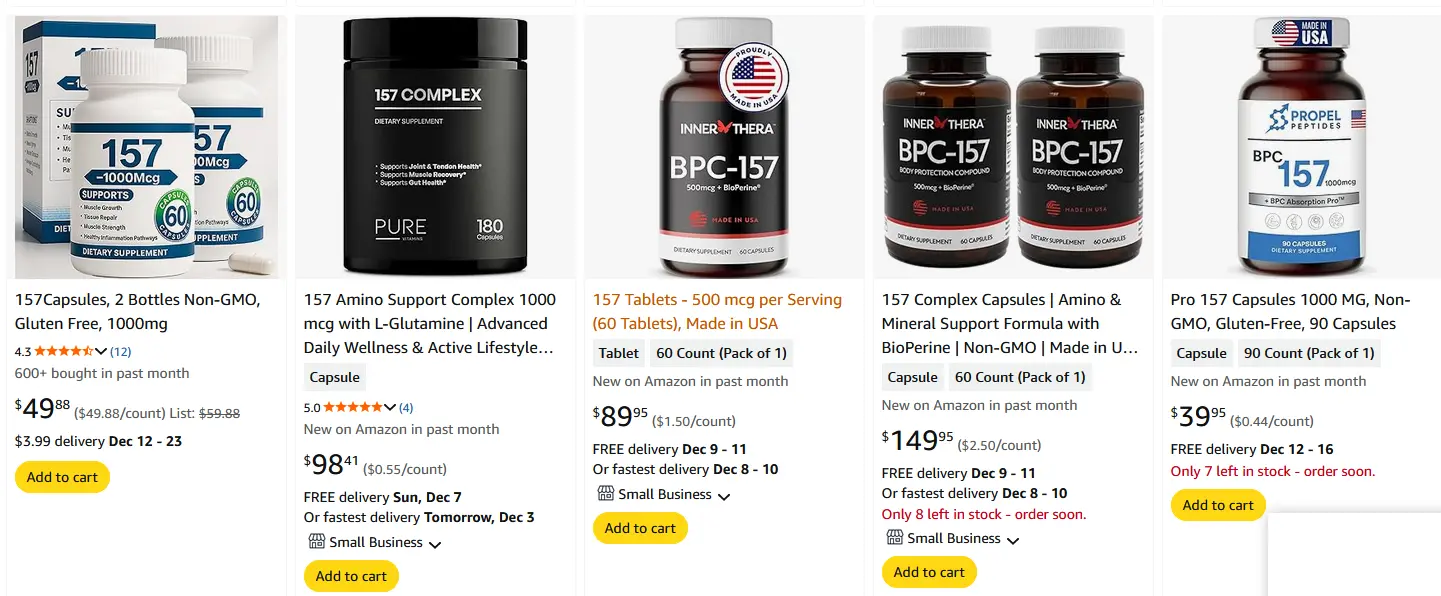
In September, Amazon had more than a hundred listings for BPC 157 products and a handful of other listings for other peptides like AOD 9604, TB 500, MOTS-C, Tesamorelin, and Sermorelin.A number of listings for peptide PEDs remain on the site with BPC 157, injectable MOTS-c, injectable AOD 9604, and TB 500 all still available. The number of listings keeps changing daily now with some being removed and new ones constantly popping up. In the AP article, Amazon said they were in the process of addressing non-compliant product listings, and they followed through and removed many of the listings, but they didn’t lock down the algorithm to keep these substances off the platform.
These peptides don’t appear on Amazon in Italy, where selling performance enhancing drugs is a criminal offense, so it is possible to lock them out. A handful of peptide products appear on Amazon in India; 4 GHRP-6 and CJC 1295 blends, a GHRP-6 product, and a IGF-1 product. So there are different peptide environments in different countries on Amazon.
Interestingly, several of the new product listings on Amazon for BPC 157 appear to come from Alibaba sellers that offer bulk peptides available in pre-made packaging for anyone to put their brand on. Here is one example of an Alibaba listing for BPC 157 that appears similar to a new Amazon BPC 157 product listing. Here is another situation where a Walmart BPC 157 listing appears to come from another Alibaba listing (these Alibaba listings have since been pulled down). Alibaba also offers a page that discusses, “How to Source High-Quality Bulk BPC 157 Suppliers: A Strategic Guide for B2B Buyers.” Alibaba appears to be a supplier of bulk product for many of the listings on Amazon and Walmart. Alibaba also sells what appears to be TB 500 marketed as a ‘hot selling 500 blend’.
BPC 157 is so popular that other retailers apparently couldn’t resist selling it either. Walmart has a handful of listings selling BPC 157 in supplement form as well. But not all retailers have followed suit. Walgreens, CVS, CostCo and other major supplement retailers have resisted selling BPC 157 and other peptides. Afterall, we are talking about research chemicals or investigational drugs that are not supposed to be for human consumption.
Does any of this really matter to you?
Well it should matter. First, many of these substances have not had any safety or efficacy studies conducted. Meaning the public serves as the guinea pigs. Using them in various doses, which have not been refined or defined leaves our bodies to determine the benefits and the risks. Surely there are many self-proclaimed body hacking experts and peptide ‘specialists’ online prepared to give you advice, but that doesn’t exactly equate to medical advice or guidance that is suggested when using supplements in general, much less research chemicals.
Some bodyhackers have the resources to use them under doctor supervision and are advanced users that carefully source peptides from what they believe to be reputable providers. Others just buy them on Amazon and figure it out on the internet. Even if you can appropriately figure out how to use them, you still can’t ensure quality in a completely unregulated environment of research chemicals. These are not dietary supplements, they are not approved drugs, they are chemicals with no good manufacturing practices (GMP) or quality control testing requirements for identity or contaminants as is required for supplements. So it is very hard to know what you’re getting in the current retail environment of research chemicals.
Many people swear by these substances. Some doctors in the integrative and regenerative medicine community believe they are miracle substances. To many satisfied users they are.
One man who contacted us believes his use of peptides like BPC 157 may have been a factor in developing a rare stomach cancer. One concerned orthopedic doctor wrote a summary on the potential connection between BPC 157 and cancer that is eye opening and suggests that the way BPC 157 works to heal by creating new blood supplies could also create new blood supplies for tumors. A review on BPC 157 was published in Current Reviews in Musculoskeletal Medicine in August 2025, acknowledging the potential benefits and unknown long term risks but noted that no adverse effects have been reported to date in available studies.
Meanwhile, some in the medical community believe the unfettered use of peptides, often guided by a colorful array of YouTubers, represents one of the most dangerous frontiers in medicine today as it leaves the patient to also be the doctor, the nurse, and the pharmacist all in one. A recent article in Men’s Journal and The Washington Post are examples of the ongoing discussion raging over the safety of peptides that followed AP reporting on unapproved peptides on November 14, 2025.
When it comes to anti-doping and clean sport we are in serious trouble when giant retailers like Amazon are once again some of the largest purveyors of performance enhancing drugs on earth. This has happened before, at least twice, and when it has it has represented periods in time where anti-doping and regulators were scrambling to catch up to illegal drugs or substances that had become mainstream.
The first time was during the prohormone heydays of the 2000s when Amazon was selling those along with many other retailers. In 2011 we wrote about Amazon selling a handful of prohormones that had been involved in the infamous Bodybuilding.com raid of 2009, which at the time was one of the largest FDA enforcement action to date. Amazon was still selling the same products a year and half later. Ultimately it took until 2014 and the Designer Anabolic Steroid Control Act to remove prohormones from the market as the whack a mole approach to regulations until then had proven ineffective.
It was also during this era that designer steroids were the preferred drug of choice for many dopers. This was when Marion Jones and Tim Montgomery were breaking world records thanks to the aid of THG, tetrahydrogestrinone, one of the most powerful designer steroids ever created. Other substances like methasterone were driving muscle building supplements like Superdrol that had taken over the internet and filtered into sport.
The great anti-doping guru, my late father Dr. Don Catlin, worked to identify and expose these substances leading to one of the largest anti-doping scandals ever with the BALCO affair in 2002. The great Don was named Chicago Tribune’s international sportsman of the year in 2003 for his work to expose BALCO, one of the first non-sportspeople to be named.
The second coming of performance enhancing drugs taking over Amazon was during the designer stimulants era that peaked a decade ago. Substances like methylhexanamine, or DMAA, led the designer stimulant revolution with products like Jack3D leading the way. At one point Jack3D was available from hundreds of sellers on Amazon. A number of substances followed in the wake of DMAA including DMBA, DMHA, higenamine, and others. Hundreds of products were on the market with these ingredients that have since been clarified as illegal. Toward the end of the designer stimulant era Jack3D and USP Labs was involved in another one of the FDA’s largest enforcement actions in history. The company executives were sentenced to significant prison terms and were required to pay millions in fines when the case came to a close in October of 2020.
Today it is peptides that have taken over. Since they are not legal to sell for human consumption some brands sell them as research chemicals with no instructions or guidance on use other than a label. Some of the consumer reviews complain about there being no instructions. This is because they can’t legally tell you how to use the peptides for fear of crossing a legal line. Other brands opt for a more straight forward approach, knowingly or unknowingly, and sell peptides openly as dietary supplements despite them not legally qualifying as such under the Dietary Supplement Health and Education Act (DSHEA). Synthetic chemicals that were designed and developed as drugs can’t be used as supplement ingredients under DSHEA, but many of them are still sold in capsules or powders as dietary supplements.
There was a dizzying array of peptides available on Amazon, and folks we are not talking about collagen peptides here. If you see something with letters and numbers in the name that is likely to be an experimental new drug that has yet to be approved or studied to demonstrate efficacy or safety. AOD 9604 and BPC 157 are perfect examples. We are talking mostly about new drug substances or developmental drugs that have fast forwarded past the clinical trials and are being made available for sale as ingestible, injectable, and inhalable chemicals for human use. Here is a peek at some of the leading peptides and the retail environment.
BPC 157 – Body Protective Compound 157 (BPC 157) is probably the hottest peptide on the market today. It is a synthetic chemical derived from a naturally present substance in the gut. In injectable form it is known as an amazing new treatment in injury recovery said to shorten and improve injury repair. In ingestible form it is sold for gut healing or healing in general. It was developed as a pharmaceutical drug and one small clinical trial was filed but it was canceled. There are no major human clinical trials that have evaluated the safety or efficacy of BPC 157. BPC 157 is on the WADA Prohibited List under category S0 – Non-Approved Substances, it is also banned in the NFL but does not yet appear on the MLB banned substance list.
AOD 9604 – AOD-9604 is a synthetic peptide derived from a modified fragment of human growth hormone (HGH), specifically the C-terminal 15–amino-acid region (with an additional amino acid added for stability). It was originally developed as an anti-obesity drug candidate because early research suggested it could stimulate lipolysis (fat breakdown) and reduce lipogenesis (fat formation) without the typical growth-promoting or IGF-1–raising effects of full HGH. It is on the WADA Prohibited List in category S2 Peptide Hormones and Their Releasing Factors, and also banned by professional sport leagues like MLB, but curiously it is not on the NFL list. Amazon has AOD 9604 available as a lyophilized powder for injection, with reconstitution fluid recommended along with it. They used to also recommend syringes for these types of peptides meant for injection, but those are not suggested anymore.
TB4 and TB 500 - Thymosin Beta-4 (TB4) is a naturally occurring peptide involved in cell migration, tissue repair, angiogenesis, and inflammation regulation. It can also be synthesized. TB-500 is a synthetic fragment of TB4 that is also found on the peptide market. They are not FDA-approved for any medical purpose. TB4 has been investigated for wound healing, muscle and cardiac repair, and eye injuries, though human evidence remains limited and long-term safety in humans is not well established. A BPC 157 and TB4 blend was previously available on Amazon with the page no longer found, now you can still find TB 500 in supplement form. Both TB4 and TB 500 are on the WADA Prohibited List and also banned by MLB, but it they are not yet on the NFL list.
Tesamorelin, Sermorelin, Ipamorelin – Tesamorelin, Sermorelin, and Ipamorelin are human growth hormone (GH) releasing hormones (GHRH) also known as growth hormone secretagogues, but they differ in structure, approval status, and clinical use. Tesamorelin is an FDA-approved synthetic GHRH analog used to reduce visceral fat in HIV-associated lipodystrophy and reliably increases GH and insulin growth factor 1 (IGF-1). Sermorelin, also a GHRH analog, was once FDA-approved for pediatric GH deficiency but is no longer marketed; today it is used off-label through compounding and stimulates GH with a more physiologic pulsatile pattern. Ipamorelin is a synthetic ghrelin-mimicking GHRP that selectively stimulates GH release without significant effects on cortisol or prolactin, and it is sold only as a research peptide with no FDA-approved medical use. All three are prohibited by WADA in category S2 as growth hormone secretagogues and are also banned in the MLB and NFL. These used to be available for sale on Amazon but many of the listings have been removed. The original sermorelin injectable product is not currently available but another ingestible sermorelin has popped up. The tesamorelin product link was completely vaporized off Amazon, the page can’t be found, perhaps because tesamorelin is an FDA approved drug and selling it without a prescription is not legal. Tesamorelin and ipamorelin do not appear to be available on Amazon today.
MOTS-c - MOTS-c is a small mitochondrial-derived peptide (16 amino acids) that regulates metabolism, enhances insulin sensitivity, and helps cells respond to metabolic stress. It plays a role in promoting fat oxidation, improving glucose utilization, and supporting exercise performance in preclinical and early human studies. Research suggests MOTS-c may mimic effects of exercise by activating AMPK pathways. Human data are still limited, and long-term safety is unknown. It is not FDA-approved for any medical use. Because of its potential to enhance metabolic efficiency and endurance, MOTS-c is on the WADA Prohibited List in category S4. Metabolic Modulators, but it is not yet banned by MLB or NFL. MOTS-c was still available as a lyophilized powder for injection on Amazon from two sellers as of December 1, 2025.
These peptide substances also share something in common. If you look at the anti-doping statistics and the number of reported positives over the last decade there have been only a handful of positive drug tests across all these substances combined. With the mainstream availability of these substances you would expect athletes to be using them, but the positive statistics don’t show that, at least not yet.
There appears to be a major gap in detection capabilities for the peptides that has yet to be filled, and until that happens the peptide problem in sport may remain largely invisible. Significant financial resources will be needed to improve the detection of peptides in the future.
Some of the peptides reviewed here are banned in Olympic sport but not yet in professional sport, or only in one league but not another showing the challenges these peptides present to anti-doping administrators and sports leagues. Many of these new substances appear so fast and with little efficacy support in the literature making it difficult for anti-doping authorities to properly evaluate and consider if they are a problem from the standpoint of performance enhancement. Meanwhile the guinea pigs are figuring out if these peptides enhance performance every day. The bodyhacking community reports that they are extremely effective.
In the previous eras, it took some time for anti-doping testing and capabilities to catch up with the trends in mainstream substance development. But eventually they did and the prohormone and designer stimulant holes that existed previously in sport drug testing were closed. It seems that has yet to happen with peptides, but it could any day and when it does there will likely be many athlete’s testing positive in the wake.
Unannounced, the great Don famously introduced a new test for darbepoietin at the Salt Lake Olympic Games in 2002 with a handful of medals winners being caught in a doping scandal that rocked those Games. My crystal ball sees something like that with peptides in the future.
Until then the peptide problem is growing and changing every day and it likely will remain one of the biggest challenges for retailers, anti-doping authorities, government regulators, the medical community, and consumer safety advocates to address over the next decade or more. If we want to allow for these potentially miracle peptides to be available to the mainstream we must figure out a way to do it in a more responsible way. Right now some retailers are part of the problem, we need them to be part of the solution.
Companies like Alibaba or others that want to be Olympic Partners, or sponsors of other professional sports or leagues, need to take that opportunity seriously and hold themselves to a higher standard when it comes to the sale of research chemicals and peptides that are also performance enhancing drugs.
Amazon should be commended for efforts over the last several years to drastically improve dietary supplement compliance policies now requiring validation of GMP audits, label claim and contaminant testing, and screening for active pharmaceutical ingredients in high risk dietary supplement categories like sports nutrition, weight loss, and sexual enhancement. They also have an extensive list of restricted products. If they added these peptides to the list that might be a very simple solution. So, while there are problems there are also solutions.
Retailers and groups like the Global Retailer and Manufacturing Alliance (GRMA) can help by setting policies against the sale of these research chemicals until they are managed in a way that ensures proper consumer protection and quality control. If we want to make room for these substances the FDA can help by giving these research chemicals and peptides a proper category. Call them what they are so consumers are aware they are using research chemicals and experimental drugs. Provide available studies and information on efficacy and safety so consumers can make informed decisions. Make sure they are subject to proper GMP and quality control testing. Then we may have a good pathway forward for retailers and consumers. The integrative medicine community can help by demanding the substances that drive the industry are managed in a way that provides responsible access to peptides with proper protection for patients, which requires some kind of reasonable regulations and expectation for quality control. The anti-doping community can help by working with national regulators to address these substances and manage them better. The supplement industry can help by declaring research chemicals are not dietary supplements to make it clear to consumers that supplements and research chemicals are not the same thing. In short, we can all do a part in addressing the peptide explosion in more effective and protective ways in the future.
In sport, the mainstream explosion of peptides risks letting sport devolve into a battle of the best chemists and doctors once again, not the best athletes. We’ve seen that movie before. If we wanted to see it again we would watch the Enhanced Games, not the Olympic Games, baseball or football. More resources and novel testing methods are desperately needed, like genetic sequencing and targeting, which my veterinarian colleague David Nash and colleagues used to detect genetic traces of equine disease. Approaches like that might hold the answer for detecting peptides better in the future. Whatever the future holds for these peptides let’s hope they can be managed better than the current unregulated retail free for all.
CERTIFIED CLIENTS
Search by Lot, Product, Brand, Category, or Other Keyword.
Certified Drug Free
Certified Quality
Certified GMP
Certified CBD