What to Include in a Supplement Laboratory Testing Brief for Comparable Quotes
Sep 21, 2026
A complete laboratory testing brief states what the product is, what each test must measure, how sensitive the method must be, and what the report must contain. When those four elements are fixed in writing, dietary supplement testing laboratories can price the same work, and a brand can compare quotes line by line. When they are missing, each laboratory fills the gaps with its own assumptions. The result is quotes that differ in scope rather than in value, and the lowest price may cover the least testing.
The brief does not need to be long. A two-page document with a formula sheet, a label, a test list with target limits, a sample plan, and a deliverables list is sufficient for many finished products and ingredients. The sections below explain each element, why it changes price, and how to read the quotes that come back.
What Are Dietary Supplement Testing Laboratories?
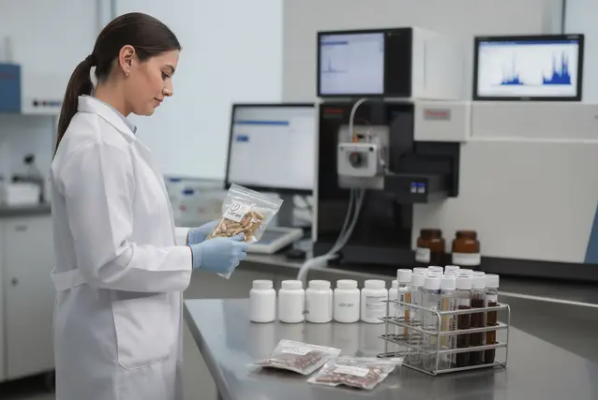
Dietary supplement testing laboratories are analytical facilities that examine ingredients and finished supplements for identity, strength, composition, purity, and contamination. They use chemical, microbiological, and instrumental methods such as chromatography, mass spectrometry, and ICP-MS. Results support manufacturer release decisions, retailer requirements, and third-party certification, and are issued as a certificate of analysis for each tested lot.
What Is a Laboratory Testing Brief?
A laboratory testing brief is the written request a brand sends to one or more laboratories before asking for a quote. It defines the product, the tests, the methods or performance requirements, the sample plan, the timeline, and the deliverables. Procurement teams sometimes call it a request for quote (RFQ) or scope of work. The purpose is the same: every laboratory prices identical work.
Why Supplement Testing Quotes Are Hard to Compare
Quotes diverge because laboratories make different technical choices when the brief leaves them open. Key variables are listed below.
- Analyte count. A "heavy metals panel" can mean four elements or twenty. SGS Galson, for example, prices metals panels in tiers by the number of elements requested.
- Reporting limit. A method with a higher reporting limit generally costs less than one that reports lower levels. Only a sufficiently low limit allows a meaningful comparison against a daily intake threshold such as California's Proposition 65 lead level of 0.5 micrograms per day.
- Matrix. Gummies, oils, softgels, and botanical extracts often need extra extraction or cleanup. Laboratories may add matrix surcharges or method development time that a powder would not require.
- Confirmation. Some screens report a presumptive result. Others include confirmation and quantification of any finding by a second technique. These are different services at different prices.
- Accreditation status. A test run under a laboratory's ISO/IEC 17025 accredited scope is not the same deliverable as the same test run as non-accredited work, even if the price is similar.
The Nine Elements of a Complete Testing Brief
1. Product description and dosage form
State the product name, dosage form (capsule, tablet, powder, gummy, liquid, softgel), serving size, servings per container, and net weight per unit. Note whether the sample is a finished retail unit, a bulk blend, or a raw ingredient. Identify high-fat, high-sugar, or highly pigmented matrices explicitly, because these affect extraction and instrument choice. If the product is a botanical, give the Latin binomial, plant part, and extract ratio or solvent used.
2. Complete formula and label
Attach the full Supplement Facts panel and a confidential formula sheet with each ingredient, its amount per serving, and its supplier. Laboratories need this to select methods, check for interfering ingredients, and confirm that reference standards exist for each analyte. BSCG asks for the same documents at the start of its certification process: the label, a formula sheet with ingredient amounts and suppliers, and manufacturing facility information. For Amazon-related quotes, BSCG requests a copy of each label and a list of the specific ingredient claims to be verified.
3. Purpose of the testing
The purpose determines the standard the laboratory must meet. State one or more of the following:
- GMP release or specification testing under 21 CFR Part 111. The laboratory must use a scientifically valid method appropriate for each specification.
- Marketplace compliance. Amazon's U.S. dietary supplement policy requires verification through an authorized third-party testing, inspection, and certification (TIC) provider. Amazon states that if a brand uses a laboratory it has not authorized, an authorized TIC provider must validate the results.
- Banned substance screening for sport, military, or professional league use. Here the analyte list should reference a specific prohibited list, such as the current WADA Prohibited List.
- Investigation or dispute. A consumer complaint, a positive drug test, or a supplier dispute may require chain-of-custody handling and quantification, not just a screen.
4. Test list with methods and acceptance criteria
List every test as a separate line. For each line, name the analyte or group, the preferred method or an acceptable equivalent, and the acceptance limit the result will be judged against. Common references include:
- Elemental contaminants: lead, arsenic, cadmium, and mercury by ICP-MS, with limits from USP General Chapter <2232> or the brand's own specification.
- Microbiology: total aerobic count, yeast and mold, and specified organisms such as Salmonella, E. coli, and S. aureus, per USP <2021> and <2022>. Amazon's policy cites USP <2021>, <2022>, <561>, and <62> for the five categories it tests.
- Pesticides: a named multi-residue screen by GC-MS/MS or LC-MS/MS, generally for botanical products. Amazon's policy references NSF/ANSI 173-2024 or USP standards such as <561> for this testing.
- Residual solvents: Class 1, 2, or 3 solvents per USP <467>, relevant for extracts and oils.
- Identity: the technique must match the ingredient. FTIR may be adequate for a single-compound mineral salt. Closely related botanical species often require HPTLC, HPLC fingerprinting, or DNA methods.
- Label claim (strength): the specific markers to quantify, such as vitamin D3, caffeine, or total curcuminoids, with the label value and the tolerance. Amazon requires ingredient amounts to fall within the tolerances in 21 CFR 101.9(g) and 101.36.
- Undeclared drugs and banned substances: the number and identity of compounds screened. Amazon requires testing for the adulterants listed in NSF/ANSI 173-2024, sections 5.3.5.1 to 5.3.5.4, for bodybuilding, joint health, sexual enhancement, sports nutrition, and weight management products.
Ask each laboratory to name the exact method it will use. "Heavy metals" without a method is not a comparable line item.
5. Required reporting limits
State the limit of quantification (LOQ) you need for each analyte in your matrix, or ask the laboratory to state theirs. A quote that omits reporting limits cannot be compared to one that includes them. For banned substance screens, the detection level determines what a screen can show, which is why BSCG's certification comparison treats low-ppb detection and public thresholds as points to check.
6. Sample quantity, lot information, and shipping
Specify how many lots you will submit, how many units per lot, and whether units are sealed retail packages. Ask the laboratory to state the minimum sample mass it needs per test, since destructive tests on small-serving products can require many units.
Include lot numbers, manufacturing date, expiry date, and storage requirements. Cold-chain or light-sensitive products need this stated up front.
Keep your own reserve samples separate from what you ship. FDA requires manufacturers to retain reserve samples of each finished product lot at twice the quantity needed for all required tests, stored under labeled conditions, for one year past shelf life or two years from the last distribution.
7. Accreditation, scope, and subcontracting
Require a current ISO/IEC 17025 accreditation certificate and a link to the accredited scope. ISO/IEC 17025 is the international standard for laboratory competence and valid results. The scope document is what matters: it lists the specific methods, analytes, and matrices the accreditation covers.
Ask the laboratory to mark which lines in your brief fall inside its accredited scope, which will be run as validated but non-accredited work, and which will be subcontracted. For subcontracted tests, request the subcontractor's name and accreditation status. Certification programs commonly set this requirement for their own partners; BSCG states that its testing is performed through ISO 17025 accredited laboratory partners.
8. Turnaround time and confirmation policy
State the turnaround you need in business days from sample receipt, and ask for both standard and rush pricing. Ask specifically whether the quoted time and price include confirmation and quantification of any positive finding, or whether these trigger a second fee and a second clock.
Published turnaround times vary. BSCG publishes 10 to 15 business days for its banned substance testing, including confirmation and quantification, and about 20 business days for its Certified Quality panel that includes label claims, heavy metals, microbiological agents, and pesticides. SGS reports two to four weeks for Amazon verification depending on product complexity.
9. Deliverables and data retention
Define what the certificate of analysis must contain. At minimum, this includes:
- Product name and lot number
- Laboratory name and accreditation number
- Method reference for each result
- Result with units matching the label, and the reporting limit
- Date of analysis and an authorized signature
State whether you need raw data such as chromatograms or spectra, and whether the report must be submitted to a third party (a TIC provider, a certifier, or a retailer). Ask how long the laboratory retains samples and data, and whether re-analysis of a retained sample carries a fee. Request an example report before you commit.
How to Read the Quotes That Come Back
Compare quotes as a grid, with one row per test line from your brief and one column per laboratory. For each cell, record the price, the method, the reporting limit, the accreditation status, and the turnaround. A quote is complete only when every cell is filled. Common gaps to look for:
- A panel price with no list of the individual analytes covered.
- No reporting limit, or a limit stated for a clean matrix rather than your product.
- Confirmation testing listed as "if required" with no price.
- Sample quantity left to be "confirmed at receipt," which can add units and delay.
- No statement of which tests are subcontracted.
- Accreditation claimed for the laboratory but not for the specific method.
Price differences that remain after every cell is filled reflect real differences in the work. Price differences that disappear once gaps are filled were never real.
Where Certification Programs Fit in the Brief
Third-party certification programs combine a defined testing menu with a review of the product and its manufacturer. BSCG's published process, for example, includes information gathering, an ingredient assessment, a quality control review, lot testing, and a public listing of certified lots. If a brand plans to pursue certification, the brief should say so, because the program's menu replaces part of the test list.
Programs differ in scope. NSF Certified for Sport, Informed Sport, Informed Choice, the Cologne List, HASTA, and BSCG Certified Drug Free all operate certification programs for banned substances in sport, and a brand should obtain the testing menu and process documents from any program it is considering. BSCG offers a comparison chart of these five programs.
BSCG's published menu is one example of the level of detail a brief can specify. The testing menu lists more than 450 drugs, including more than 400 on the WADA Prohibited List and more than 50 prescription, over-the-counter, and illicit drugs not banned in sport. It states that it covers the drugs in Amazon's compliance testing requirements. It also publishes its reporting rule: any detected sport-banned compound is reported, while compounds not banned in sport are held to a published threshold of 0.0005 percent and/or 10 micrograms per day at the suggested serving, with findings below that level still reported.
The Certified Quality program covers identity, one or two label markers, heavy metals, pesticides, microbiology, and the same banned substance screen on one lot per year, with additional markers available separately.
Certification and standalone testing are not interchangeable. A certificate of analysis on a single lot documents that lot only. Certification adds a review of the formula, the manufacturer's quality system, and ongoing lot testing in a marketable package. BSCG's comparison of testing and certification explains the distinction.
Regulatory Considerations That Shape the Brief
Component identity cannot be delegated. Under 21 CFR 111.75, a manufacturer must conduct at least one appropriate test to verify the identity of each dietary ingredient before use. Supplier certificates of analysis may be relied on for other specifications only under a documented supplier qualification program. A brief for raw material testing should therefore always include an identity line.
Finished product specifications must cover five attributes. 21 CFR 111.70 requires specifications for identity, purity, strength, composition, and limits on contaminants. A brief that omits any of these for a finished product leaves a gap in the release record, whether or not a laboratory quotes it.
Retailer requirements add tests but do not replace GMP. Amazon's policy requires a GMP audit or certification from an accredited third party and states that private, first-party, and consulting audits are not accepted. For the five higher-risk categories it adds heavy metal, microbial, label claim, and adulterant testing, with pesticide testing based on a review of the finished product components.
Ingredient screening is a separate consideration. Before a formula reaches a laboratory, the brand can check each ingredient against public resources such as the BSCG Dietary Supplement Ingredient Advisory List, which identifies compounds including SARMs, unapproved peptides, and synthetic stimulants that do not qualify as lawful dietary ingredients. Amazon's policy separately lists named peptides and GLP-1 receptor agonists among ingredients it prohibits. No test plan resolves a formula that contains a prohibited ingredient by design.
Frequently Asked Questions
Why do reporting limits matter in a testing brief?
A brief that lists tests without the required sensitivity for each analyte in the product's matrix produces quotes that cannot be compared. Without a stated LOQ, laboratories quote to their default method, and the resulting numbers are not comparable. State the limit you need or require each laboratory to state the limit it will deliver.
How many samples should a brand send to a dietary supplement testing laboratory?
Enough to cover every test plus retained sample, as stated by the laboratory for your dosage form. Small-serving products and destructive tests consume more units. BSCG uses about 200 g to conduct label claims and environmental contaminant screening commonly needed for Amazon verification, and individual laboratories may require more. Ask for the minimum per test in the quote, and keep FDA reserve samples separately.
Does ISO/IEC 17025 accreditation mean every test at the laboratory is accredited?
No. Accreditation applies to the methods, analytes, and matrices listed on the laboratory's scope document. A laboratory can be accredited and still run some requested tests as non-accredited work or subcontract them. Ask the laboratory to identify the accreditation status of each line in your brief.
Should the brief name specific methods, or leave method selection to the laboratory?
Name a preferred method or a recognized standard and allow equivalent alternatives. This gives laboratories room to use their validated procedures while keeping quotes comparable. For each line, require the laboratory to name the method it will actually use, so that any substitution is visible before work begins.
Can one brief cover both Amazon compliance and sport banned substance testing?
Yes, if it lists the requirements separately. Amazon requires adulterant testing per NSF/ANSI 173 for five product categories, along with contaminant and label claim testing, submitted through an authorized TIC provider. Sport programs screen against a broader list, such as the WADA Prohibited List. Some testing menus, including BSCG's, state that they cover both sets of drugs. The brief should still name each requirement so the laboratory can confirm coverage.
What should a certificate of analysis include for the results to be usable?
Product name and lot number, laboratory name and accreditation identifier, the method used for each result, the result with units that match the label, the reporting limit, the date of analysis, and an authorized signature. Amazon also requires that documents be authentic and unmodified originals. Request an example report during quoting to confirm the format meets your needs.
Summary
A laboratory testing brief produces comparable quotes when it fixes the variables laboratories would otherwise decide for themselves. Those variables are the product and its matrix, the complete formula, the purpose, and each test with its method and acceptance limit. They also include the reporting limits, the sample plan, accreditation and subcontracting expectations, turnaround and confirmation policy, and the deliverables. Quotes that still differ after these are fixed reflect real differences in scope or capability.
The brief also has limits. It documents the tests requested for the lots submitted. It does not substitute for the manufacturer's own specification program under 21 CFR Part 111, and a single certificate of analysis does not establish ongoing quality across lots.
Testing verifies what a formula contains; it does not make an unlawful ingredient lawful. Brands that understand these boundaries can use laboratory quotes for what they are: a priced statement of exactly what will be measured, and to what limit.
CERTIFIED CLIENTS
Search by Lot, Product, Brand, Category, or Other Keyword.
Certified Drug Free
Certified Quality
Certified GMP
Certified CBD